Friday, March 9, 2012

Big markets and big cities

Our last two stops in Ecuador were Otavalo and Quito. We took an overnight bus from Puerto Lopez to Quito, which was actually a really nice bus, one of the nicest ones we have been in (it even had air conditioning!) We arrived around 5 am to Quito and immediately took a taxi to the bus terminal (because of course the nice buses never leave from the real bus terminal, plus htere are multiple bus terminals in Quito since it's a big city). From there, we hopped on the next bus to Otavalo (which is only about 2 hours away). When we got off the bus, we went to the first cafe we saw and got coffee and pastries. Then, we headed out to find a hotel. Otavalo is where one of the largest markets (artesinal, livestock, produce...basically whatever you can think of that they would make a market for is all there at the same time) in South America. It was also the beginning of Carnaval festivities, which took place during the weekend we were in Quito through the Tuesday that we went to Colombia. So, our nice hike to a waterfall outside of town ended up being caught in the middle of beginning-of-Carnaval-festivities aka school kids out of school on Friday for the long weekend with lots of silly string and being thrown in rivers. Saturday, which is the market day, the whole town was taken over by stands selling various things. All the streets were lined with merchants...it was quite a sight. After shopping and just enjoying the market for most of the day, we headed back to Quito. Because it was Carnaval, almsot all of the hostels were full (which is ironic considering none of the locals are actually in Quito and the city itself is fairly dead).
We eventually found a nice hostel that actually ended up being really cozy with nice old man running it who made us a yummy breakfast every morning. We had 3 days in Quito, which we spent exploring various parts of the city. I think Quito was my favorite city of the trip...it just had a cool vibe and was pretty set in the valley (although we never actually got to see the famous view of the volcano because it's the rainy season and it was cloudy every day). We stayed in "new city," but my favorite part of the town was old city, with it's old colonial architecture. Also, a highlight to our time in Quito, we got to see The Girl with the Dragon tattoo (nice thing about South America, I can actually afford to go to the movies).
Waterfall! (before being attacked by Ecuadorian school children in the spirit of Carnaval)
After being attacked by Ecuadorian school children. We had already been sprayed multiple times with silly string (in reality it's more of a silly foam) by several different kids. But, we had managed to escape water and flour thus far. So, we were walking around, enjoying the scenery, being amused by the kids spraying each other with silly string and the boys throwing the girls in the water. A group of giggling girls runs past us, we think nothing of it, and before we know it, several high school boys are dragging US towards the water. Maya and I had both assumed they would keep pursuing the girls...but apparently two foreign girls were more appealing. So, we were dragged (half-willing, since we figured it's all part of the experience, right?) to the river where the proceeded to dunk us, fully clothed, into the river. Luckily, the let us go one at a time and we got to hold each other's backpacks during the dunking so our cameras didn't get ruined. Anyways, it was an interesting experience. Kids+carnaval=crazy Friday afternoons.
A woman dressed in typical traditional dress for the region. We bought really warm, soft alpaca blankets from her.
The beautiful green hills surrounding Otavalo.
Some old colonial buildings in "Old City" Ecuador. I really liked this style. And they were all pained in really pretty pastel colors and had nice balconies.
Looking down the street towards the hill with the virgin that overlooks the city (all cities down here seem to either have a virgin or Jesus statue on a hill overlooking them.)
An old gothic-style church. Now it's just used as a museum (which we didn't go into, because we didn't want to pay. Our theory on churches: if you have to pay to go in, it's not longer actually used as a church, it's just used as a museum.) But the outside was incredible to look at. It looked like something straight out of Europe. We saw it from the main Plaza and decided to hike up to it while we were waiting for our turn to go into the presidential palace...definitely worth the straight uphill walk.
The two guards guarding the entrance to the presidential palace (he just works there, he doesn't live there).
A courtyard inside the palace.
Overlooking the plaza from the second story of the palace.
A gift from the US to Ecuador!
Ecuadorian flag. It was really awkward, when we first walked into the place and went upstairs our guide told everyone to salute the flag. I was a little taken aback by that...I don't think I've ever been asked to salute the flag of another country. The had a flag in a display case with a little carpet in front and everyone stopped and bowed in the front of the flag. Maya and I just kind of walked up to it and looked at, then quickly stepped aside. (I'm pretty sure we were the only ones not from Ecuador on the tour).
Also during the tour, the guide was showing some artifacts from a famous person in Ecuador (I can't remember his name now...) Everyone knew exactly who he was talking about except us. So a few sentences into his story, he stops, looks at us, and goes, "Oh, for the people who aren't form Ecuador, this person was famous because he helped Ecuador gain their independence..." Slightly embarrassing and funny all at the same time.
Our last day in Ecuador (and the next blog post)...we went to...La Mitad del Mundo!! Aka, the equator

Tuesday, February 28, 2012

Blue-footed boobies and beautiful sunsets

Our time in Puerto Lopez is better told in pictures. Basically, it's this really cute beach town on the edge of a national park. The beach is beautiful, the water is the perfect temperature, and the wildlife is awesome. Most of our time was spent hanging out on the beach and enjoying the water and scenery, but we did a few activities as well. One day we went out to Isla de la Plata (which is often referred to as "Poor Man's Galapagos") and saw lots of cool birds, fish and other wildlife. And, on our last day, we went parasailing!
Our first sunset over the bay in Puerto Lopez.
Our second sunset over the bay in Puerto Lopez. I swear the sky turned all the colors of the rainbow.
The most amazing batidos (smoothies)!!! I think I drank one every day we were in Puerot Lopez. They were all made with fresh fruit: pineapple, blackberry, passion fruit... My favorite was a blackberry-passion fruit combo--the waitress thought I was really weird when I ordered it. She asked me about 3 times to confirm that was what I wanted.
On the boat out to Isla de la Plata! We were getting on our boat at the same time that all the fisherman were coming in from their morning catch. That means that the stretch of beach where all the boats are anchored was turned into a gutting station. We saw everything from hammerhead sharks (sad :( ) to every specie of fish imaginable. There was one guy walking up to the shore with a bin full of fish on his head, which the birds were attacking trying to steal the fish they could.
First giant sea turtle spotting! (Prize if you can actually find it in this picture, I swear it's there beneath the water).
Welcome to Isla de la Plata! One cool thing we learned: you can volunteer to save baby sea turtles! The giant sea turtles that we saw swimming around in the ocean lay their eggs on the shore. Then, the volunteers help keep the eggs safe so that more baby sea turtles survive.
A baby blue-footed booby! These birds were the main reason I was so excited for Ecuador. This one is a baby, which is why it's feet are blue-grey and also why it's not scared of people--it has grown up with people walking around the island where it lives. Also, it can't fly yet, hence why it's on the ground. These guys were all over the path where we were hiking. Our guide kept telling us we had to "ask them permission to pass."
The whole island is so green!
An older blue-footed booby, with real blue feet.
After snorkeling off the shore of Isla de la Plata. We saw so many brightly colored fish, eels and sea turtles!
Los Frailes beach, one of the most beautiful beaches I have ever been to. The water was crystal clear, although we still had to be careful with the current (there are some really strong currents off the coast off Ecuador, I definitely got tossed around by the waves a fair number of times.) In addition to the beautiful water, the whole coast was green with white sand.
All along the beach in Puerto Lopez there were bars with hammocks and comfy beach chairs. We enjoyed having a drink with our toes in the sand.
Getting prepared for parasailing! The made sure I was strapped in really well because Maya took a little tumble during her takeoff. The guy who ran the parasailing was from Kentucky, but he had retired to Puerto Lopez. How he decided on Puerto Lopez, Ecuador? Google, I kid you not.
Parasailing up above the bay! It was really relaxing and had great views. Even landing in the water was nice. I swear I saw a sea turtle while I was up in the air.

I basically fell in love with Ecuador while we were there, and I know I will go back sometime during my life. It's just such a beautiful country and the people are really nice. I think Puerto Lopez was one of my favorite places during my vacation thus far.

Guayaquil: where pigeons and iguanas frolick together in the plaza

Our first stop in Ecuador was a brief stay over in Guayaquil, the second biggest city in the country. Our bus got in late in the evening, so we decided to spend the night and head out the next morning for Puerto Lopez. While we were in the city, we decided that rather than just holing up in our hotel room we would at least stop by the plaza. We had a heard a lot of rumors that Guayaquil wasn't particularly safe or a particularly nice city. So, we decided to take a cab to the plaza even though it was only 7 blocks away. Although the city itself wasn't super exciting (at least the parts we saw) the plaza was definitely worth the $1.50 cab ride.
As we were asking for directions to the plaza, the concierge referred to as "Plaza de las Iguanas." I didn't understand what he meant until we got there...
Here are some photos from our brief time. (in reverse order, sorry).
The biggest bus terminal I have ever been it. It was three stories tall, complete with shopping mall, grocery store, several banks, as well as ticket offices. When we first pulling in the night before, I was in awe. It was right next door to the airport, and I'm pretty sure the bus terminal was bigger than the airport, I'm not kidding. Apparently they just rebuilt it a few years ago; before it was rebuilt and they had new security and everything, supposedly it was really dangerous, but now it's okay. You didn't even have to pay to go to the bathroom...and it was clean!
One of the, literally, hundred iguanas wandering around the square. They were all different shapes and sizes and colors. When we first got to the plaza, I was looking at the church and Maya came up me and told me "I just saw an iguana in the square!" I thought that as pretty cool, so I went over to try and see the iguana she had seen, only for both of us to realize that the ENTIRE plaza was filled with iguanas roaming around.
In addition to iguanas wandering around, there were turtles and fish swimming in the pond and pigeons eating out of peoples hands (I personally would never let a pigeon that close to me). It was kind of like an outdoor mini-zoo or something.
The main cathedral (and a statue of someone who I can't remember, most like the person who helped Ecuador get there freedom, they usually get a statue in the main plaza). The church was really beautiful both inside and out.

Wednesday, February 22, 2012

Huaca (huaca hey, hey)


(For those who don't get the above reference, Shakira sings a song called Waka Waka which she made for the 2011 World Cup, the name of the pyramids are pronounced the same as her song. You can listen to the song here, if you feel so inspired: http://www.youtube.com/watch?v=pRpeEdMmmQ0 it's actually pretty good, in my opinion). The day after Chan Chan we headed to some more ruins: La Huaca del Sol y La Huaca de la Luna. As far as I can tell, "huaca" means the same things as "pyramid and/or temple," although I am sure there is some difference. (Here's the definition according to Wikipedia: In Quechua, a Native American language of South America, a huaca orwaqa is an object that represents something revered, typically a monument of some kind. The term huaca can refer to natural locations, such as immense rocks. Some huacas have been associated with veneration and ritual. Andean cultures believed every object has a physical presence and two camaquen (spirits), one to create it & another to animate it. They would invoke its spirits for the object to function.) Oh, and sol=sun and luna=moon.
Anyways, both of the Huacas were really impressive. The Huacas were constructed by the Moche civilization between 100BC-800AD. This part of their civilization consisted of two large pyramids (the Huacas) with a residential area located in between the two. La Huaca de la Luna was built against a mountain, and eventually, (with all the layers) ended up essentially being built into the mountain. La Huaca del Sol is located opposite the Huaca de la Luna, with the houses in between. Over they years, they would decide to build a new layer of the huaca over the whole huaca, creating a "new huaca". Once a new layer was constructed, it was not possible to access the previous layers.
Thus far, they have only excavated the inside of Huaca de la Luna. We got to take a tour and see the inside of the huaca, which was awesome. Huaca de la Luna is the smaller of the two, but they think that it was the more important one religiously. It is comprised of 5 layers-back in the day, it was only possible to go on the outermost layer. Now, however, various layers are excavated and we got to see a little peek from the third all the way up to the fifth layers. Each layer has the same basic plan, just with the rooms in different places.
My favorite part of the huaca were the paintings. There are different designs all around the inside and outside-and the are all original, including the colors. It was so cool to see paintings that were made 2000 years ago and are still in pristine condition.
Okay, so here are a few tidbits from the day :)
This is the room where the would prepare prisoners (and other people) for sacrifice. This was the first part of the Huaca we saw.
The big, natural rock is the sacrificial rock. Yes, back in the day, they sacrificed people there. The rock was a natural part of the mountain, they didn't put it there, they just decided it would make a good sacrificial place. Initially, the rock was up behind the Huaca. However, as the Huaca expanded and kept getting built onto, the rock became sort of incorporated into the Huaca. It was never in the middle of the Huaca, rather at the back of it by the 4th and 5th layers. Unlike the Mayas and Aztecs, when the Moche sacrificed people, only the important religious figures were allowed. It was not a town event. After the sacrifice, however, the priest would bring the blood of the sacrificee out in a cup for all to see.
One of the well preserved paintings. According to our guide, they have not doing anything to restore it. It is some sort of feline-looking figure because felines were considered to be divine. You can clearly see the colors of red, yellow, black and white.
This the residential sector, located in between the two Huacas. I think it looks like a model in this picture, but it's the real deal! Archaeology students from one of the local universities get to come and excavate it...pretty cool! They still have not excavated very much of the residential section, but it is a work in progress.
The main plaza of la Huaca de la Luna. The opening in the top of the Huaca is where the priest would come out to show the cup of blood to the village. Everyone would gather in the plaza where I am standing to watch. On the wall is painted a hierarchy of the society: prisoners on the bottom, then workers (if I remember correctly), spiders, a feline figure, and finally the snake up at the top.
Align Center
Another really cool painting, even more well preserved than the other one.
Welcome to the Huacas de Moche!

After our visit to the Huacas, we spent the rest of the afternoon in Trujillo people watching, enjoying the beach and killing time until our bus to Piura (and then Guayaquil, Ecuador) that night. These pictures are in reverse order...sorry
On the bus from Piura, Peru to Guayaquil, Ecuador. A beautiful sunset over a banana farm in Ecuador. I was amazed at the colors in the sky and how green everything was.
Crossing the border! Welcome to Ecuador!
The sexiest bus outfit you ever did see. The Cruz del Sur bus terminal was really nice, they checked our luggage in and everything, just like an airport. And, the bus was by far the nicest I have been on in Peru. It was just as nice or nicer than the ones I take in Chile. Too bad the direct to Guayaquil was already sold out :(
The famous reed boats in Huanchaco. Apparently the fisherman have built and used them for thousands of years. The go out early in the morning and in the late afternoon to get the days catch. It's quite impressive to watch them tackle the waves in their little tiny reed boats, just perched on top.
A beautiful sunset off the coast of Huanchaco. The balcony from our hostel overlooked this view. And we could hear the waves from our room as we fell asleep.

Friday, February 17, 2012

Chan Chan: The largest adobe city in the world

On the day after we arrived in Trujillo/Huanchaco, we decided to go to Chan Chan (more ruins! and one of our main reasons for stopping in that area). It is (or was?) the largest adobe city in the world, built by the Chimu culture. You can see how expansive just the ruins that are left are from driving by on the road. Only a very small part of it has been restored, and, according to all of the tour books it's not a good idea to go wandering around the other parts of the site because there have been reports of "violent attacks on tourists." So, Maya and I decided to stay in just the part that was restored and had security guards. When we first arrived in the morning, the site was still closed because it had rained the night before (this causes the walls to essentially melt sine they are made of dirt). They told us, however, that it would open in up in about hour. So, to kill time we went into Trujillo to get bus tickets for Guayaquil (which ended up being sold out the day we wanted to go with the company we wanted to go with, so we just got tickets with that company to Piura where the plan was to change buses for one up to Guayaquil). When we came back, the site was open (oh yes, we also had to take the $5 dollar taxi instead of the 50 cent bus because the tour books say not to walk along the road unless you are in a big group, because, again, there have been reports of attacks on tourists...get your stuff together Peru!!) Anyways, we decided our safety was worth the extra couple dollars. To get from the highway to the restored part of the ruins you drive through the rest of the city which as not been restored. It seems like there are adobe walls that go on FOREVER. And, considering the whole thing is made out of mud, it's quite impressive how much of it has stood the test of time and rain and everything else that has been thrown at it (it was constructed around 850 AD and was the largest pre-colombian city in South America). At it's high point, around 60,000 people lived in the city...that's a lot for a mud city!
Here's some picture's from the day:
The melting wall of the city after the rain :( You're not really allowed to touch everything for fear that it will crumble. I'm guessing children were discouraged from having waterfights back in the day...
Apparently every time it rains they just try and through tarps over the part of the city that has been restored. Then, when the rain passes, the walk around with a bag of dirt to restore the parts that have been ruined.
Random lake in the middle of the city. Apparently after the city was abandoned, they used this area for leaving offerings for the gods. (I'm a little unclear about whether there was always a lake or not).
A room where they think that kept statues of their gods and also left them offerings.
The fish signs that guided us through our self guided tour of the city. follow the yellow fish-sign...
Maya and I are guessing that these were probably houses, although they didn't have a sign to clarify for us. There were a bunch of little square boxes that all looked the same. And, in the background, you can see the really tall wall that ran around the whole city.
I can't believe they made so much stuff out of mud! It's crazy. It also seems slightly impractical, although I guess since we're still looking at it 1200 years later, it wasn't such a bad idea after all. The whole city was like a labyrinth, because you couldn't see over any of the walls. I don't understand how people didn't get lost back in the day, they didn't have those nice little yellow fish signs to guide them through the city...
Some really cool designs they carved into the wall. The fish are supposed to be in the shape of ocean waves. Their culture depended a lot on the ocean for nutrients, so they would make offerings and carve designs about it to bring them good luck and food.
A guy wandering around dressed in "period" dress like the nobility. They would wear gold plated shirts, headresses, necklaces, nose pieces, earings...etc.
The main plaza. The nobility would stand up at the front under a little shade structure. (The awnings that are there now are not a representation, theyre just there to help protect the walls and carvings from the rain.)
Welcome to Chan Chan archeolgical site!

Tuesday, February 14, 2012

Thousands year old gruesome battle scenes

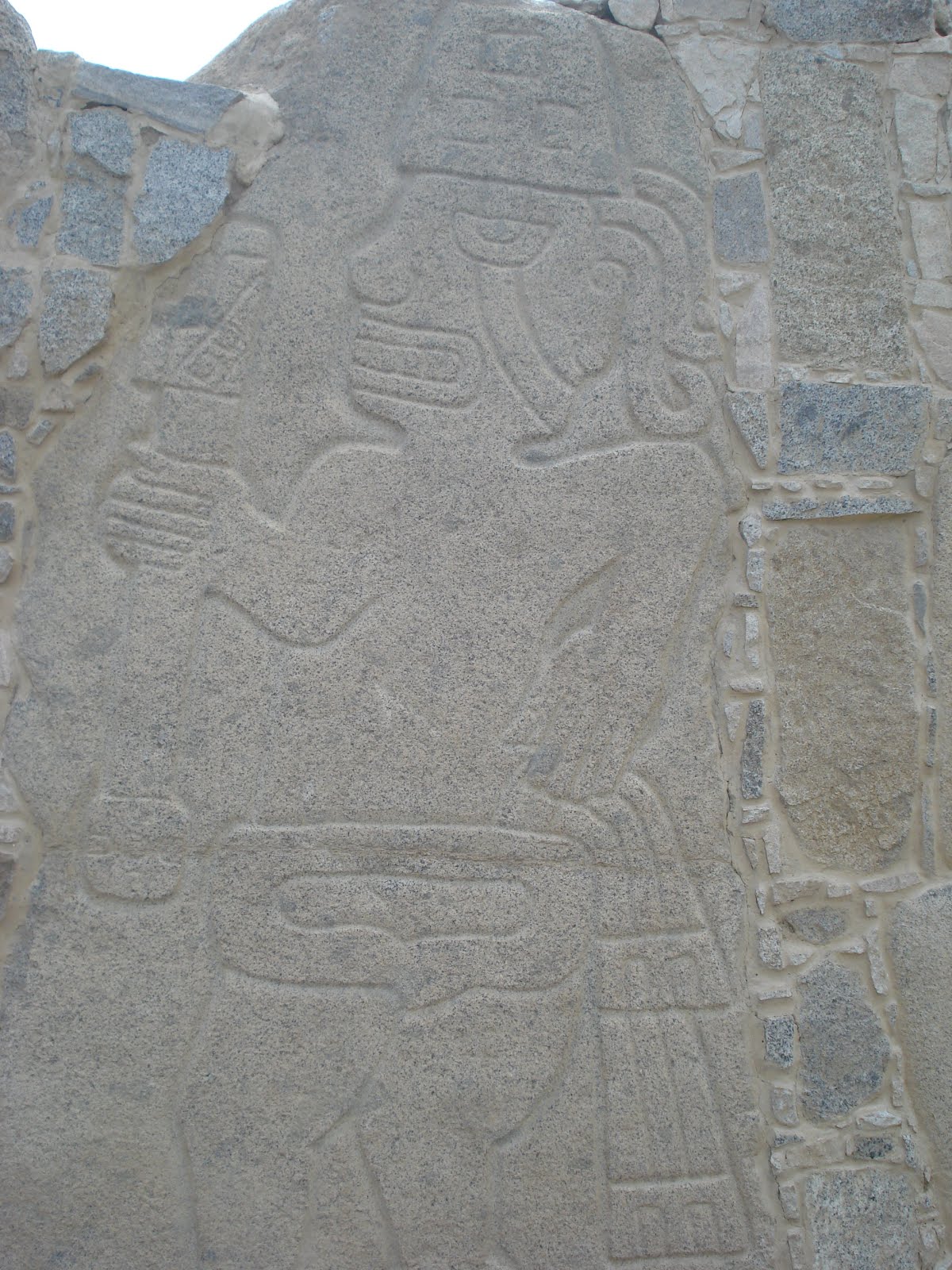
After Huaraz, we headed back to Peru's coast, and thus, the desert. I have to say, going to Peru, I thought the coast line was going to be more tropically, like it is up here in Ecuador. I guess that's my own fault for being ignorant and not doing my research before heading on my journey. Anyways, I guess it makes for lots of cool, preserved ruins. Of course, what did Maya and I do but go see more ruins? :) This time it was just a small religious site; it seemed tiny in comparison to the other ruins we had been visiting. I'm not sure which culture used it (I'm not sure if the archaeologists know), but it is most famous for the gruesome battle scene that is depicted on the outside wall of the main structure. There was also a small museum at the site that had some artifacts found at the site on display and a limited amount of information about the site available.
We arrived there by mototaxi (a three wheeled taxi called a tuk tuk in Guatemala and a rickshaw in India). It was only about 5km out of town, but we had to drive down the side of the road since the mototaxi didn't go very fast, it was kind of funny. On the way back, one of the guards from the site took us home. He just went and grabbed one of the many mototaxi they had laying around and took us back into town.
The site, as I said before, was really small, but I'm still glad we went to go see it.
A creepy, ugly, hairless dog of Peru. For some reason, these guys are all over the towns in northern Peru. But they're always peoples pets, not the stray ones roaming around. They're really ugly, but really fascinating at the same time. What kind of dog doesn't have hair??
One of many heads depicted on the wall. Apparently, all the heads that were just floating on the wall were supposed to be people who had been decapitated during battle. This one is spewing blood from i t's mouth.

Some people still had bodies. I assume they were the victorious ones in battle. I think this guy most be nobility, or at least someone important, since he has a headdress and walking stick/weapon thing in his hand.
That little square down below me...that's the whole site. It was so tiny! It seemed so small compared to everything else we had seen. But when we got up close and could see the carvings in the walls it seemed pretty impressive.
A (recreation?) of a sculpture they found at the site.
Mummy in the museum. With a really, really scary expression on her face. It said they thought she was asphyxiated.