Saturday, February 4, 2012

Caral: La ciudad mas antigua de las Americas

Although I never learned about it in school, there was civilization in Peru that dates back from before Ancient Egypt, to 5000 BC. According to the museum we visited in Caral, Peru, the civilization that existed in Caral was established around the year 5000 BC. Mesopotamia, which we learn about in school, was in power around 5200 BC, and Ancient Egypt, which we also learn about, was in power around 4800 BC. According to Maya (she is my history expert, because she studies all about Latin America back in Santa Barbara) Caral was not as advanced as some of the other ancient civilizations (Mesopotamia, Egypt, China, India), but I don't think that's any reason to leave it out of a textbook! There's still evidence that it existed.
In any case, they had a some artifacts that they had found at the site in the museum, plus we took a guided tour (it was the only way they would let us in, but it actually ended up being interesting).
The main part of the site is 5 pyramids, in a sort of semi-circular area. The upper class lived at the base of the pyramids and the middle class also lived inside the complex. The lower class, however, had to live outside of the main part of the city. We weren't allowed to visit that part, because they are doing a bunch of excavation and restoration work of the site (our "guide" was actually an archaeologist who has to give tours to tourists because they don't trust us to wander around on our own...)
During it's high point, about 3000 people were living in Caral. The civilization as a whole, however, expanded over the entire Supe Valley. While we were driving from Barranca, we saw other ruins off to the side of the road, presumably from the same civilization. However, they have only found 3 dead bodies thus far, so they think that they had a cemetery somewhere in the valley, they just haven't found where yet.
The place where we were staying, Barranca, was by far one of the skechiest places we have been (sorry Mom and Dad, didn't think I should disclose that informatin up front), but they guy who ran our hotel was really great. He always helped us grab a cab, gave us really good directions on how to get places, and would tell us where not to go. And, he wouldn't let us out at night by ourselves, he always made sure we went in a cab and that we went to a restaurant he knew. The drive to the ruins was about an hour. We first had catch a colective (shared taxi) over to the next town, and then from there, catch a colectivo to the modern day city of Caral. It was an interesting drive, though. It was my first time really being in the desert (and it's really desert there, why did all the really old civilizations decide to live in the desert??), but all along the valley floor, it was super green, which I thought was weird.
In any case, I was in awe that I was walking around one of the oldest civilizations in the world. Oh, the ruins weren't even discovered until 1994...maybe that's why I didn't learn about it in school, but Amelia and Eli's textbooks have no excuse...
After we got dropped off by the colectivo in Caral we had to walk about 15 minutes to get to the entrance of the ruins. The path was nice and shady (thank goodness!) and had a little stream running alongside it. Everything that was near the stream was green, everything else was brown.
Welcome to the Caral! The oldest (surviving...remaining...ruins? I'm not sure of the right word) city in the Americas!
Looking out over the pyramids. The hat that's in my hand? The hotel owner insisted that I bring it along since there is no shade at the ruins and I am very white. I was a little hesitant to wear it at first, but after doing a thorough inspection decided it was clean, and that it was hot outside, and I probably would burn my face without it (even with the copious amounts of sunscreen I applied). Besides, Maya said I looked like an archaeologist with it, haha.
Some steps leading up to one of the pyramids. We weren't allowed to climb on any of them because of the restorations :(
Maya and I in front of the most famous pyramid at Caral. Apparently it was the most "religious" one. The little circular courtyard in front apparently has some rooms underneath it where the priests used to go and have some "visions." (You an guess what they were doing down there...)

The ampitheater. I'm not exactly sure what they did there...
Me sitting on one of the sand dunes. I was going to climb farther up but was really tired after only going this far. The desert is such a crazy place.
The modern day city of Caral, not too far outside the ruins (3 km I think).

It was really fun and interesting to learn about a new civilization that existed so long ago...and most people never even learn about! The pyramids look like a mini version of how I imagine the pyramids in Egypt to look like. Hopefully someday I'll actually be able to make that comparison!

Friday, February 3, 2012

Lima: La ciudad del color de caca

In the words of the famous Peruvian author Mario Vargas Llosa "Lima es la ciudad del color de caca," translated: Lima, the city the color of shit. And so goes many people's view of Lima. However, Maya and I decided that we had heard of some cool things to do there, and wanted to give it a shot. I wasn't expecting a whole lot, and was pleasantly surprised. I actually think Lima is a rather pleasant city. While some parts may be the color of...well, you know...in general, I thought it was pretty, especially the parts of town on the beach and the center of town. We stayed in the part of town called "Miraflores," which is one of the upper class neighborhoods. It is perched atop the cliffs overlooking the ocean, which creates some spectacular views when it's not fogged in.
Our first night we didn't do much. We both arrived from Cusco on a plane and were tired, plus I was sick, so we just decided to go to the hostel and relax. The next day, we decided to head down to the center of town. Our roommate, a girl from Germany, told us there was a changing of the guards in front of the Palacio del Gobierno at 11:30am, so we made it in time to see that. We took Lima's "metro" downtown. It's essentially lane's that are just for the "metro bus," and it's surprisingly effective and fast, since there is a lot of traffic around the city. There are stations, just like metro stations, just instead of getting on a metro train, you get on a bus. I was impressed...way to be creative Lima. We watched the changing of the guards which took a full hour! You had to stand across the street from the Palacio and there were police all over, it was like they were expecting a riot or something during the changing. Anyways, it was fun to watch. After that, we walked around the plaza, saw the main cathedral, and walked down the paseo (a street just for pedestrians) from the Plaza de Armas to the Plaza San Martin, where everything is white: the plaza, the buildings... After that, we headed back up the Paseo to find a restaurant for lunch (set menu's are the best deal in Peru). We spent the rest of the day wandering around the center of the city. That evening, we went to Larcomar, a really nice mall on the cliffs overlooking the ocean and saw the move The Ides of March (it was really good, I recommend it). It basically discusses how awful politics and politicians in the US are.
The next day we went to an anthropology museum called Museo Larco (named after the guy who discovered a bunch of the artifacts). Maya had heard about it from one of her professor's at Santa Barbara--it was by far one of the best museums I have been to in a long time. It talks about all the ancient civilizations in Peru, apart from the Inca's (although it talks a little about the Inca's too). I had no idea that so many ancient civilizations existed! There have been civilizations in Peru since 5000 BC...aka as long as Mesopotamia and Egypt. However, they often get ignored because their societies were not as elaborate as the Incan society. There were artificats from all different regions and time periods, and I learned A LOT about the history of civilizations in the Americas. Their "temporary exhibit" was on phallic pottery, yes, sex pottery. Apparently the Moche civilization was really into fertility, so they would water their plants with things like penis pots because they believed they were giving them life. It was really hard to be mature during that exhibit.
That afternoon we tried to paragliding, but with no luck because the coast was completely fogged in. We instead made an appointment to go the next day to some mountains to the south of Lima, where it doesn't get fogged in. Instead, we went and got manicure's and pedicure's :) The manicure and pedicure were amazing after having walked around Cusco and Lima for a week and a half. On our way, we stopped and had another set lunch menu, including our first taste of Peruvian ceviche (spelled cebiche sometimes in Peru...anyone who can explain why..?) Delicious.
The next morning we got up and checked out and headed to go paragliding. We got a "tour" of the city on our way out of town, which was interesting because we left from Miraflores, one of the upper-class neighborhoods, but then had to drive through some of the poorer parts of town on our way to Pachamac (where we were paragliding). It seemed like there was an even greater contrast here than in Santiago, which was interesting.
Paragliding was amazing. I don't really know how to describe the sensation, it's like flying outside I guess. The takeoff and landing were surprisingly smooth. It was like, one minute my feet were on the ground, the next minute they weren't, and vice-versa for landing. I got to go up pretty high because the way the winds were blowing, which was awesome. We were over the town of Pachamac, plus got an ocean view...pretty cool.
Here are some pictures from Lima, in reverse order (sorry):

The view of the coast from Larcomar.


Paragliding in Pachamac. That little dot up there is me.
Manicure's and pedicure's
Posing with some manikin's in Larcomar. It's a really, really nice mall. And very obviously for the upper-class.
Some phallic fertility pottery.
Some more phallic fertility potter...there were all varities.
The "storeroom" of pottery and Museo Larco. There were 4 big rooms filled with shelves from floor to ceiling which were filled with pottery from different civilizations. It was really impressive. These are some of the few pots they have found of women.
Some of the wear of the nobility. They had their choice of gold or silver, sometimes embedded with other precious stones. In most ancient cultures in Peru, gold and silver were regarded as equally precious metals. I just can't imagine wearing those nose and earring pieces...
Some of the pottery from the oldest civilizations. They can date how old the pottery is by things such as how many spouts it has, how long the spouts are, how the pottery is glazed, and what the pottery is depicting. I think that is quite impressive. Also, it was stunning how elaborate some of the early pottery was.
Maya and I in the Plaza de Armas. Why are the buildings are yellow...I don't know. Maybe that's where Lima gets its reputation for being the color de caca.
Changing of the guards in front of the Palacio del Gobierno. There was a live band and a march. In this part, everyone had a mini Peruvian flag and it almost looked like they were about to start charging each other with flags in hand. They didn't however, and instead turned toward the front of the Palace and changed the guards.

Monday, January 30, 2012

The Lost City: Machu Picchu

After taking the taxi from Cusco to Ollayantaytambo, we took the train from Ollay to Aguas Calientes, or "Machu Picchu City," because it is the city where everyone stays to go to Machu Picchu. Aguas Calientes is a tiny town, you can walk across the whole city in about 5 or 10 minutes. Everything is aimed at tourism since it is the entry point to Machu Picchu. All the same, it was cute and not a bad place to stay for a few nights. The first day, we decided to hike up to Machu Picchu. Aguas Calienetes is in a valley at the BOTTOM of the mountains, Machu Picchu is set at the TOP of those same mountains. It took about an hour and half for us to walk from our hostel to the entrance: 30 minutes from town to the "trailhead" and then one hour up stairs straight up the side of a mountain. It was a really beautiful hike though. And, of course, since it's rainy season right now, it rained on us the whole hike up in the morning and the whole hike down in the afternoon. We didn't count, but some Argentinian's told us that there were 1,460 (or something like that) stairs from the bottom to the top of the mountain. In any case, there were a LOT, and with the altitude, about 8,000 feet above sea level, it was quite a hike.
However, when we arrived and got our first glance of the city, I was in awe. Three best words to sum up how I felt: INCREDIBLE, AWESOME, INSPIRING. It's just so crazy to think that the Inca's built this city before there was all the technology available and everything. And just how intricate the city is, wow. The city was a lot different than any of the Aztec and Mayan ruins I have been to, more city-like and less pyramid-y. Anyways, I could go on and on about how much I loved Machu Picchu, but I'll just show some photos instead to try and transmit how amazing the ruins are.


First view of the city with Maya. The part behind us is the main part of the city, with all the practical, city stuff. Maya informed me (she has studied ancient civilizations) that Machu Picchu was built as a "vacation home" for the Incan emperor. WOW.
At the sun gate. Apparently the "proper" entry into Machu Picchu.

The main entryway into the main part of the city.
Hanging out inside the city. These were the people I spent time with in Cusco: me, Karen, Lewis and Maya.


Looking out over the mountains and valley. The Inca's had a pretty nice view from their windows.
Enjoying looking out over the city. A lot of the ruins have been reconstructed to make the city look more complete, so it's hard to tell what is actually original. But it's quite impressive to see how the city may have actually looked (minus the roofs)
Llamas grazing in the main plaza of the city. They are "imported" (aka, they put them there for tourism sake) to demonstrate that even back in the days of the Inca, they used llamas to transport good.
Hanging out in some of the windows up near the observatory.
Look at how close together all the rocks in the walls are...impressive. Apparently the didn't really even use anything to hold them together, like we would today. Also, imagine even putting those rocks in place...I know I'm not strong enough.

Well, there are a few of my favorite pictures from our first day :) I can understand why it's called "the Lost City" for two reasons (I don't actually know the real reason...): it is buried so high up in the mountains that why would be wandering up there and also during the rainy season, it is constantly covered by clouds, making it really hard to see. It's more like the "disappearing city" during rainy season.


Sunday, January 29, 2012

Cusco: the land of the Incas

Well I am skipping a lot of my summer adventures in hopes of trying to stay somewhat caught up with my tirp that I am now on: Peru, Ecuador and Colombia. I have been waiting for and planning this trip practically since I arrived in Chile, so it is pretty awesome that it has all been able to come together :)
On the night of the 20th, I said goodbye to my Mom, Amelia and Eli. It was definitely really hard, I wasn't ready for them to leave yet. But, we had a great time while they were down here and I am so happy they got to come visit me. Then, on the night of the 21st, I headed out. Although it was hard to say goodbye to Santiago and everyone there for 5 weeks, I was really, really excited for my trip.
I first took a plane from Santiago to Lima and spent th e first night in Lima. It was quite uneventful since I only had about 12 hours I didn't really go anywhere, just to my hotel by the airport, and then back to airport in the morning. But then, I was off on the first part of my adventure: Cusco, the Sacred Valley and Machu Picchu. Flying into Cusco was gorgeous. First we crossed over the Andes, then into the valley of Cusco. Everything around the city is GREEN, that was the first thing that I noticed. And all of the roofs in the city are red, making a really nice contrast. Coming in for landing, we made a really tight turn around one of the mountains and then landed in what appeared to be the middle of the city.

My first afternoon in Cusco we didn’t do much. I took a taxi from the airport to downtown (funny story about that…I decided to take a taxi from the inside the airport since only “official taxi’s” are allowed inside the airport proper and I had heard horror stories of people being violently assaulted in taxis in Peru. But, I tried to bargain with the guy to take me for s./10 instead of the s./15 he was trying to get me to pay. He told me it would be s/12 if I went out the street for a taxi—a total lie, but that’s okay—so I just decided to pay the s./15 for my peace of mind. When we got to the Plaza de Armas, where he was taking me, I only had a s/10 bill or an s/50 bill. He didn’t have change for s/50, so after thinking for about a minute and trying to find a way to get change, he gave it to me for s/10 anyways J ) As soon as I was standing in the plaza I realized what everyone meant when they said that Cusco is a beautiful city. It really is gorgeous…all the architecture, the way the streets are laid out. Maya and I had decided we would meet in front of the church at 1pm, and it was only about 12:15, so I sat down on a bench to do some people watching. Of course, after being there for about 20 minutes, it started to rain, so I had to run over to the overhang on the edge of the Plaza and squint towards the church hoping to see Maya. Luckily, I met up with her without a problem. She was traveling with two other people: a friend from England and a friend from Australia. Both were really cool and easy to travel with, and we all had a great time.

We decided we were going to go to Machu Picchu for 2 days, leaving the on Tuesday and returning on Thursday. Monday morning we spent running around to all the different agencies getting tickets, etc (of course nothing is in the same place…) We got everything worked out, train tickets in hand, Machu Picchu and Wayna Picchu tickets, hostel reservation in Aguas Calientes, taxi from Cusco to Ollyantatambo (where the train leaves from) and our “tourist ticket” for the Sacred Valley (all the other ruins and museums in and around Cusco).

We had initially been planning to hike up to a ruin called Saqusaywaman (acronym “Sexy Woman,” real meaning “Satisfied Hawk” in Quechua) but because it was so late by the time we finished everything and we were all hungry, we decided to go to museums in the city for that day and climb Saqusaywaman when we came back to Cusco. We ended up going to three museum that day: Contemporary Art, the Museum of Qoricancha (some old Incan ruins in the city) and the chocolate museum.


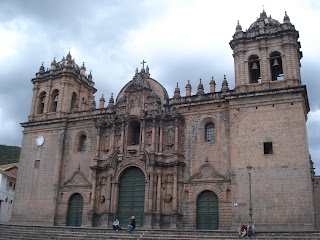
This is the big church I met Maya in front of. It is HUGE, and I think by far the most elegant building in all of Cusco. I didn’t actually get to go inside because you have to get a separate ticket (they charge for EVERYTHING in Cusco), but just the outside was gorgeous. Also, there are church-like buildings about every other block in Cusco (on the Plaza de Armas itself there are two), I’m not really sure why there are so many. The “real” church (aka the one that is open for masses and such) is not actually on the main plaza, it’s about a block off of it. We did get to go inside that one, and it was also really beautiful.


There were lots of interesting paintings and sculptures inside. This is one of my favorites, depicting Machu Picchu in the clouds. It looks so mysterious and hidden, and I’m sure you can you understand why it is called the “lost city” if it’s always covered in layer of clouds! (Which is was for most of the day when we were there, since it's the rainy season.)


Here is the outside of the Art Museum. It’s in a smaller plaza located about a block off the main plaza. As I said, the architecture in Cusco is amazing and this building is just one example. On top is the Incan flag (not gay pride, as all guide books tell you), which is flown next to the Peruvian flag all around the Sacred Valley.

This is the site of Qoricancha. The big black-ish wall is the remains of the wall the Incas built, the church behind is what the conquistadores built. I believe that it was a Temple of the Sun, but I’m not completely sure. Inside the museum were artifacts they had found from around the valley…including Incan mummies!


This a delicious Peruvian dish called Aji de Gallina. It is kind of like yellow curry, except thicker. Peruvian cuisine is AMAZING. So many delicious foods and flavors. And the best part? You can get a set lunch menu for s/10-15, aka $3-5, for a lot of yummy food.

On the drive from Cusco to Ollyantaytambo. We decided to hire a taxi to take us because it was only about $2 more each, and then we could go on our time schedule. the drive between the two towns was breathtaking. We drove up through mountains and all around us were green hills and deep valleys. This is just a small glance at the incredible scenary. It just seemed like everywhere we turned the landscape got even more incredible.

Saturday, January 14, 2012

The first visitors

As the end of my first semester came to a close, my first visitors came into town: my Dad and Gray. I cannot explain how wonderful it was to see some familiar faces from home. While I love Santiago and my friends here, it's always amazing to see your family and old friends from home. Anyways, I ended up having to meet up with them at my apartment because I had a test the day the arrived (lame), but everything worked out rather smoothly for them getting from the airport to my apartment (minus a minor taxi mishap that was easily fixed, thank goodness). I only got to see them for 24 hours because then they headed out to Buenos Aires for a few days, which actually ended up working out perfectly because I had my finals to finish up.
In any case, the end of the semester in Chile wasn't too different from any other end of the semester: stressful, lots of tests and essays. One nice surprise did happen though: I showed up to one of my exams only to be told I didn't have to take it because I had a high enough grade in the class! I guess that is sort of a common thing here, and it was definitely a huge sigh of relief for me. Other than that, everything ended up going pretty well at the end of the semester. I now that I passed all my classes...another good sign ;)
When my Dad and Gray got back from Buenos Aires we took a few days to check out the city. We walked around my neighborhood and downtown area, and I did my best to share the knowledge I had of the city. I felt a little bad, because I kept having to leave them to go do school stuff, but I tried to get stuff done the quickest I could to enjoy maximum time. It was kind of weird taking people around the city, and realizing how well I actually do know the city now, and how, just by chance of living there, I have already seen most of the major tourist sites.
One of my favorite nights that we spent together was Thanksgiving. I had my last final the morning of Thanksgiving (which was weird to have school on Thanksgiving), which was actually nice because the I could enjoy the evening and not be stressing out about school that night. We all shopping at La Vega, the big open air vegetable market in Santiago, for the freshiest veggies for dinner. Then we hopped on the metro and went to one of the biggest supermarkets in town (called Jumbo) to find the rest of our supplies. All and all, we were fairly successful in finding everything. Once we were loaded up, we headed back to my place to cook. My kitchen, and especially my oven, are not of the highest quality, so we had to do our best with what we had.
Gray and I prepared most of the food (mostly Gray teaching me what to do...), and surprisingly, there were no major mishaps :) We made some of the traditional foods and improvised some of the others: chicken (instead of turkey), cooked veggies, salad, beans and bacon, potatoes, pie... We had scheduled to have dinner at 8, so of course no one showed up until 9, which actually ended up working out well because the food was all ready at the point.
It was a really fun Thanksgiving, even if it was not the traditional one. I'm so glad that my Dad and Gray could be there to share it with me and that they were willing to prepare a big dinner and invite people over, in the Thanksgiving spirit. And, I'm so grateful that Gray was there to help prepare everything or I would have been completely lost! We were the only United Statsiens (I can't say Americans anymore, it has been drilled in to me down here), so for everyone else it was there first Thanksgiving, which I think made it all the more special and fun. We had Ivan and his parents, my roommate Pauline, Barbara and Eduardo (Barbara is the amazing woman who I stayed with when I first arrived in Santiago). Everyone seemed to get along, which was a huge relief, and the night passed quickly with a mixture of talk in English and Spanish.
Somehow, Gray's time in South America came to an end way to quickly. It seemed like she had just gotten there when it was time for her to hop on a plane back up north again. It was so much fun to spend time with her and my Dad in Santiago and I'm so grateful they got the chance to come down and visit me and I was able to show them a little piece of my life in South America :)
After Gray headed back, I had one more essay to write, which of courese I put off until the last minute (not totally my fault, my teacher kept pushing back the due date so I kept putting of writing it) until finally it was 12 hours before my Dad and I were supposed to get on a plane to Bolivia and I had still only written a paragraph...So, I ended up staying up rather late the night before finishing my essay, BUT I finished in time and got it sent off to my professor and a friend to print it and turn it in for me.
The morning before my Dad and I left, we tried to go get visas from the Bolivian consulate. However, they didn't have any (how a consulate cannot have visas, I do not understand. I think the only explanation is that Chileans don't need them to enter Bolivia, and not very many US citizens try and get them in Santiago). So, after a nice scenic trip to the Bolivian embassy, we were on the metro to the airport...
(for those who didn't realize the post below this one is also new even though it says it's from November, just FYI)

Friday, November 25, 2011

Buenos Aires, continued, and Colonia

Monday: We decided to go check out the San Telmo neighborhood some more, as well as go to two big shopping, pedestrian areas. (aka cars can't drive down those streets). We spent a lot of the day just wandering around looking at the architecture and taking in the vibe of the city. We checked out a couple of places where they had tango shows and the theatre district to find a play to go to. While we were buying tickets for the theatre, we got in a long conversation with an older Argentinian woman about the linguistics of spanish, which was actually fairly interesting. We saw a lot of the city because we walked EVERYWHERE or took the bus (my theory is that once you understand the bus system of a city, you've got the city down). There is a lot of cool graffiti around the city which we enjoyed looking at. That night, we went to a tango concert at the Museo de Carlos Gardel, who is one of the most famous tango musicians. It was interesting to learn a bit about the history of tango music while listening to live bands perform. A couple of the bands were really good, and it was fun to hear a variety of bands with a variation of instruments and styles.
Tuesday: The next day we headed to an area of town called Palermo. It is now one of the upper class neighborhoods--filled with boutique shops, big green, trees (it's spring here, so all the leaves, flowers, etc are blooming) and a couple of huge, beautiful parks. The neighborhood used to be a lower-middle class working neighborhood on the outskirts of town, and it's where the famous Argentine author Jorge Luis Borges grew up. I insisted on finding his house, because it was in the guide book and I really like his work. We wandered up and down the street (named Jorge Luis Borges in his honor) and couldn't find much--I expected it to be a little museum or something, but finally we found a plaque the said "Jorge Luis Borges lived here during his childhood from 1901-1914" You would think they would preserve the places where he lived a little better seeing as he's, oh I don't know, the most famous author from Argentina. After finding his apartment, we wandered through the shops in the area and admired more street art. I really wanted to find a pair of nice leather boots (Argentina is famous for their good quality, inexpensive leather) and finally after almost giving up, I found a nice pair in a little boutique shop. After that, we headed to the parks. There are a couple of different parks are really close together--a botanical garden, Japanese tea garden, rose garden and "regular" park--and they were all so beautiful and open and green and nice to get away from the city in (Santiago is definitely lacking in this aspect of their urban planning, they don't have a nice big park to get away from the city in). First we went to the botanical garden, which had everything in full bloom since, like I said, it's currently springtime down here. Then we wandered down into the bigger area of the parking, just taking in all the greenery and open spaces. Over by one of the little lakes we saw some baby ducklings...they were very cute. Last, we made our way over to the Rose Garden. It was absolutely gorgeous, they had roses in all colors of the rainbow (literally, I even saw some blue and green ones, I'm not sure how) and of course it smelled really good all over. We spent a while just sitting on one of the benches enjoying the beautiful colors and tranquility. Then, we decided it was time to head back because we wanted to go to a tango show that night. We ended up at a café called Café Tortoni which is one of the most famous ones in the city (Borges used to frequent it). It's pretty cool on the inside, although very touristy. We had dinner and a show--the dinner was quite yummy, I got a salad and (ironically) a hamburger, and we all split some wine. The show itself was awesome. There was a live band playing the music and the dancers were incredible. The did a variety of different dances from couples to just the men to just the girls, and there was a little bit of theatrical acting mixed in. I had just read an article about the Argentine tango the night before for one of my classes, so it was fun to see everything I had just read about being acted out. It's a much sadder dance than most national dances, and it's absolutely amazing how the just whip across the stage. Needless to say, I thoroughly enjoyed the show.
Wednesday: Bright and early we headed over to the boat station to catch our boat across the river to Colonia. The boat was really nice, it was really big--three stories plus an outside deck, a café, some comfy chairs with TVs, and even a duty-free store. The ride was 3 hours across the river (it's more like the ocean than a river) and it was really pretty. While we were pushing back there were two ladies who decided to dance tango on the top deck which was fun to watch. It got really windy, though, so I decided to head inside and sat at the front of the boat so I could get a nice view of where we were headed. When you're in the middle of the river it really feels like you're in the ocean because you cannot see land anywhere, which is kind of a strange feeling since you know you're on a river. When we spotted Uruguay, we decided to head down to the bottom deck to watch as we pulled into Colonia. When we got down there, it was a pretty cool view. It was also an open deck right at the level of the water, and there were a bunch of cars! I hadn't realized before that the boat could transport cars. When we got to Colonia, I was instantly in love. It's a small little colonial city right on the river that is just peaceful and beautiful. We went to two hostels before deciding on the one we wanted...it had free bikes, instant selling point. We ended up getting our own room since there were three of us (Carolyn, her roommate Alex and me) and the hostel itself was really nice--it had a couple two big courtyards which all the rooms opened out onto. We took three bikes, signed them out and headed out on the town. Oh yeah, they had no bike locks, they said we could just leave or bikes wherever and no one would take them...weird. We were like, are you sure? And they said, yes, it's really safe, don't worry! The town has a bunch of small museums which you buy one ticket for entrance to all of them for a whopping $2.50. We went to the two museums that wouldn't be open the next day (the close on a rotating basis) and then headed to get some lunch. (Going to the museums didn't take too long since most of them were 1-5 rooms each; we went to the tile museum and indigenous museum that day). We went to a little stand by the river that served milanesa, a really delicious sandwich that they, unfortunately (or maybe fortunately for my health) don't serve in Chile. Then we walked down to the beach and munched on our sandwiches. After relaxing a little bit and enjoying the peace and quiet of being out of the big city, we headed down the road into the main part of town (where I don't think too many tourists go). It was absolutely gorgeous.

...well this is from about 2 months ago, so I will let you all enjoy this as I try and update some of my other adventures :) Basically, Buenos Aires was really fun and a much need break from school in Santiago before the final push to the end. I had a really great time exploring the city, but when it was time to go home, I was definitely ready. When I was first picking my study abroad experiences, I was kind of bummed that my school didn't have program to Buenos Aires, but now I'm really glad it turned out that way. I had a great time visiting and saw a lot of really cool things, but I love Santiago and Chile way more than I ever think I could love Argentina. Colonia was also really nice, we were blessed with amazing weather the whole time we were there, which was definitely a bonus. It was a nice little escape from the city, giving us time to just take a step back, breath and relax. Now, onward with the adventures :)

Friday, November 11, 2011

Buenos Aires

Thursday: Well, the conquistadores had one thing right when they named this city, it does have good air (note: for those who don't speak Spanish, Buenos Aires literally means Good Aires). It was so nice to see a clear, blue sky after living in Santiago for 3 months, where the brown is always a brown-ish color. I went with my friend Carolyn who is also an exchange student at La Católica from Berkeley; we decided to bus instead of pay because being an American citizen we're hit with a $150 entrance fee if we fly into an airport in Buenos Aires (because the US charges the same to Argentinian citizens). The bus ride was 20 hours...well, hypothetically. Going there it was 24 hours because were stuck at customs for 3 hours-at least we got to be out of the bus during that time. So, we left at 10 am on Thursday and arrived in Buenos Aires at 11 am on Friday morning. The 20 hours passed a lot more quickly than I thought it would, considering I slept for about 9 of it, it wasn't actually too bad. The majority of the ride is spent driving thorough the pampa of Argentina, which is kind of the equivalent of the prairie in the US, but a little different. It was actually really pretty, although I'm sure it would have gotten a little dull if I had been awake the whole time. Anyways, between reading my Lonely Planet guide and planning for my other trips this summer, watching movies, sleeping, listening to music and staring out the window, the drive passed quicker than I thought it would.
Friday: When we got to Retiro (the bus station in Buenos Aires) we went to buy our return tickets for Santiago (because we had only bought one way, and sometimes things are cheaper in Argentina; but we also knew we needed to get them right when we got there or we wouldn't want to come back to school). Then we made our way to the metro station (called the Subte...aka subterrano...aka underground in Buenos Aires); it took a few times of us asking where it was and people giving us funny looks for calling it the metro, but then we found it. Then we had to figure out which metro stop we needed to get off, so we asked some more people for help, and eventually figured everything out. The metro in Buenos Aires is very, very old and dirty, I missed the Santiago metro immediately. Luckily, we were able to get to our destination metro station without a problem; when we came out from the metro we asked for some more help in finding the street where our friends lived. (We stayed with a friend we had met in Mendoza, Argentina back in July who studies in Buenos Aires.) Finally, we found our to the apartment. We called upstairs and after a little bit of confusion (our friend was at school, so it was just his roommates who were home, but they knew we were coming), someone came down to let us in.
We went upstairs and met his other 3 roommates, all of whom are really cool, nice people. We dropped our stuff off, freshened up a little bit and then headed out on the town.
Iván (one of the roommates) was nice enough to come with us before he had to go to school to help us get oriented a little bit. We headed down to part of town called Puerto Madero because we wanted to get boat tickets to go to Uruguay. Puerto Madero is basically a part of the river that has been turned into a canal and now has restaurants lining it and a path for running, walking and biking. We walked down most of it, passing a "famous" bridge in Buenos Aires called Punte de la Mujer (Woman's bridge) that is very modern looking. It was pretty, but there wasn't a whole lot to do. We went to one of the boat places where the told us it was going to be $100 to go to Colonia, which was more expensive than what we had been hoping for; but then we went to the other place...it was even more expensive! We eventually found a deal for $60, which we ended up getting. Then we went to a pedestrian street called Avenida Florida which is one of the famous Avenidas in Buenos Aires where there are a lot of shops and street vendors. We told Iván we needed to find something to eat because we were both really hungry and starting to feel sick because we hadn't eaten since the night before (it was like 2pm at this point). So, we made our way back over by the bus station because they had the cheapest food. We got Milanesa, a really yummy sandwich that they don't have in Chile. Afterwards, Iván had to go to school so Carolyn and I headed back to the centro to kill some time before going back home.
The Plaza de Mayo is one of the main plaza's in Buenos Aires where the Casa Rosada (equivalent of the White House) and one of the main churches are. On our way we walked down the equivalent of what looked like Buenos Aires Wall Street, it was a cobblestone street with a bunch of banks on it. One thing I noticed right away when we got there: the architecture is amazing. And, as everyone says, it is definitely very European-or at least it seems like it to me. Anyways, we wandered around the Plaza de Mayo area for a while, there's a lot of buildings to see in that area because it's the "center" of town. Then, we headed back home because our friend was due to be home. That night our friend had a joint birthday party with a few of his other friends from the university; it was pretty fun-we had to dress up: Carolyn dressed up as a vagabond, I dressed up as a Chilean flag.
Saturday: The next day we went to La Boca with another friend, Diego. La Boca is an area of town where the lower class lives; historically it was where the workers who immigrated from Italy lived. Now, part of it, the older part, is converted into a tourist shops and the like, but the area is still where the lower class lives. The apartments are tiny and sometimes 6,7,8 people live in one. The historic part is really cool though because it's all painted really bright colors, and there are cool tango murals everywhere. But, you're not supposed to visit during night because it gets a little bit sketchy. We went right before dusk, but once it started to get dark, one of the store owners told us "you guys better hurry up and get out of here. It's not safe after dark, there will be a bunch of thieves and the like." so we hurried back to the bus stop to head back into town. We then walked around a little more including going to Teatro Colón which is one of the most famous theatres in Buenos Aires. You're not allowed to go inside without a tour or going to a show-we wanted to go to a show but the were the closed the first 2 times we tried to go to the ticket office and then the third time we found out there was only one show and it was the night we were coming back from Colonia so we couldn't go. But, we got to see the outside which is a work of art in itself-really beautiful architecture. Then we walked to Avenida Corrientes which is the Broadway of Buenos Aires-it was fun to walk up and down and see all the theatre's and people meandering around. Then, finally, we went to the oblisque, which look very similar to the Washington monument in DC, but is in the middle of the Avenida 9 de Julio which is supposedly the widest avenue in the world (it is pretty wide, something like 10 lanes). It's kind of funny that they just have this monument stuck in the middle of the Avenue, but you really can see it from anywhere in the city. That night we went a concert way in another part of town. I don't really know how to classify the kind of music it was, but it was really cool. It was like what I would imagine hearing in a little club in France. The club was super run down, but isn't that always where the best music comes from? The band started with a little skit which was really funny: it was a guy talking to a psychologist, who was dressed as skeleton type thing, talking about how he thought he was insane, and how he had failed his life, etc, etc and how the only thing he really wanted was for the band to play again. The psychologist murdered him, but then the band started to play. They were all wearing masks (like what you wear to a mascarade ball) and old style clothes. The music was really good, I enjoyed it a lot.
Sunday: The next morning we went to the San Telmo market, which is a famous artisan market in the neighborhood of San Telmo. We spent the whole morning just wandering up and down the street it was on because there was so much to see. It was fun to see all the different things people were making. After that we attempted to go to Teatro Colón which was, of course, closed again. So we just wandered around the city a little bit, looked into some tango shows, enjoyed the architecture. That night, we stayed home and just watched a movie with our friends, which, of course, I fell asleep during.
Okay, I think that is sufficient for now, I will continue with the rest of my week later.
PS Sorry I have not been posting as much, it's just that Chile is my normal life now, so there's not that much to post about. But, summer is coming soon, and then there will be plenty to post about :)